|
 |
 |
 |
|
| Suburban | River | Low-cost | Riverbank erosion | |
| DESCRIPTION | |
| Measures
|
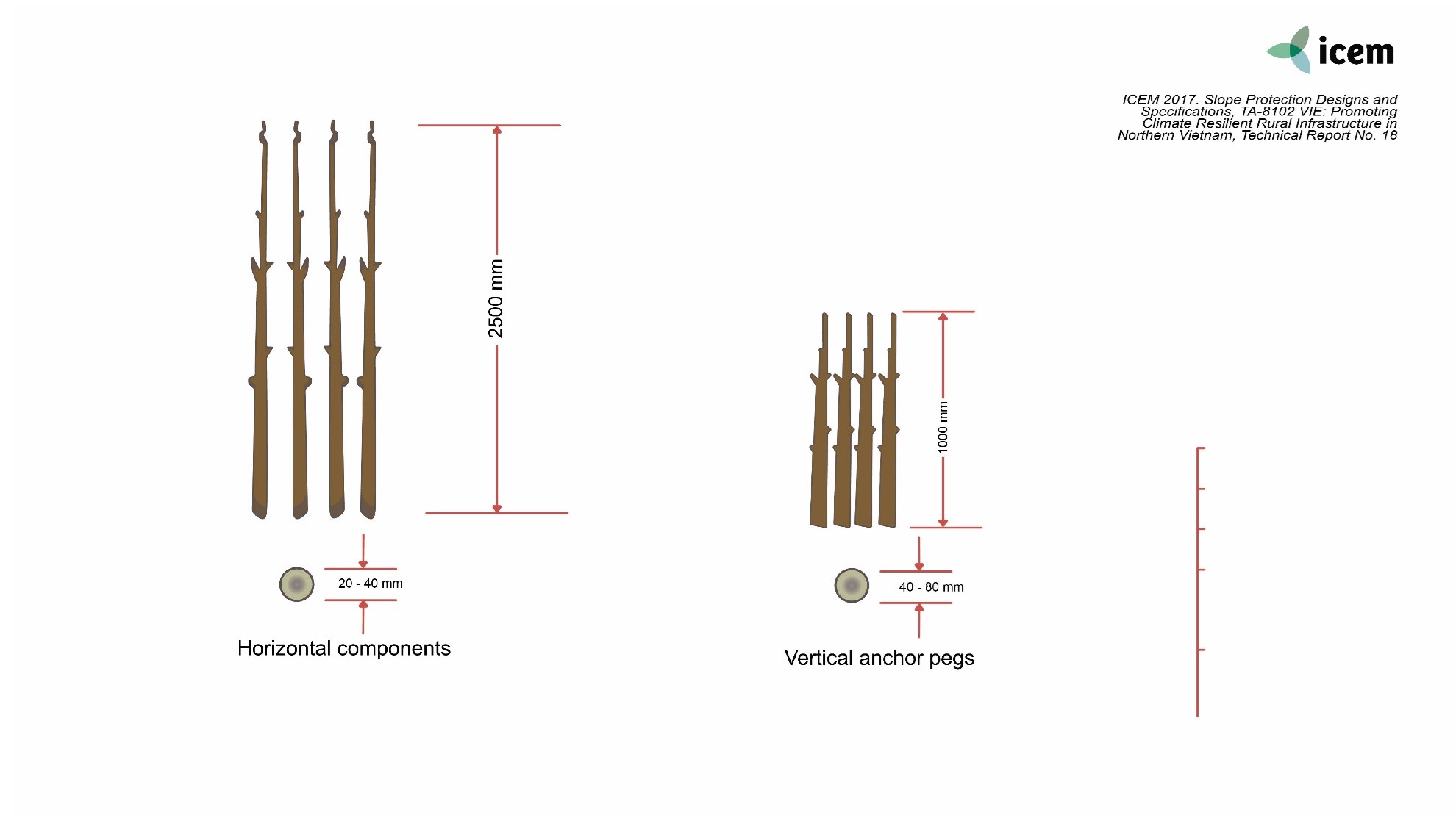
Live fences can be constructed of wattle or willows. They are constructed by placing several lines of live vertical poles along the contour of the river bank and then placing live horizontal members between the poles on the up-slope side to form parallel fences. The space behind the fence is then backfilled to form a sloping terrace up to the next fence. Willow fencing, known as willow spilling is a traditional form of riverbank stabilization or revetment used mainly in the UK. Slender willow rods are woven around upright willow posts driven into the stream bank where erosion is occurring to form a fence-like structure that is then backfilled with soil to form a physical barrier against erosion by fast-flowing water. Willow rods and posts are live so in spring they take root and send shoots into the soil thus stabilizing the bank. The outside of the structure has a rough surface which slows the river flow near the bank allowing the slow-moving water to deposit the silt at the base. In time the silt deposits and spreading roots stabilize the bank and create a habitat for wildlife. |
| Location
|
This method is suitable for steep banks and does not require heavy equipment so it causes minimal disturbance to the river environment. Since willow is very flexible and strong in tension willow fences can also be constructed out into the channel, to deflect flow away from the bank and promote deposition near the bank to alter the course of the stream. |
| Design options and performance | Live fences can provide protection and support to eroding river banks within a wide range of soil types and flows. Steep or high banks should be terraced or re-profiled before installing the live fence. |
| Feasibility criteria
|
● Technical design: Live stakes should be from 1 to 2 m long with pointed ends and should be hammered to two-thirds of the length into the ground at the toe of the bank. Soil should be moist and soft soil so that the roots can start to grow and penetrate to a greater depth, providing greater stabilization. The long thin horizontal rods should be woven between the vertical posts and fixed with twine. Their ends should be tied back so that when backfilling is placed behind the fence they are buried in the soil. Installation should be done in the winter period to take advantage of the spring growth period. If the bank is higher than 0.6 m the live fence should be constructed in tiers.
● Soil media: n/a ● Soil slope: Willow fences can be used for very steep banks since the willow is very flexible and strong in tension. If wattle or birch is used the slope angle should not exceed 45° ● Surface cover: n/a ● Materials: Live cuttings, twine and iron bar to make holes |
| Operation and maintenance | Replacement of some stakes which fail to grow may be needed but otherwise, no maintenance is required unless the vegetation impacts other activities in the stream or riverbank. |
| Cost and benefits | This is a low-cost measure that becomes very effective at stabilizing the bank as the root systems and foliage growth. It also adds to the biodiversity of the site and creates new habitats. |
| Design solution
|
Wattle fences are short retaining walls constructed of living cuttings. They are used to protect slopes and enable plant growth where a steep gradient is preventing plant establishment. The section shows the effects of steeper slopes on wattle fence spacing. |
| Environmental performance | Live plant material in the form of a fence can be used to stabilize steep, unstable slopes. The emergence of shoots and root systems then initiates further processes that will establish a long-lasting vegetation cover on the bank. Pioneering species like willows that should be used for the initial planting will provide conditions that encourage the establishment of other species, and eventually ensure a healthy vegetation cover. Even difficult steep slopes can be transformed into a long-lasting diverse ecological environment. |
| Sources | ● ICEM, 2017. Slope Protection Designs and Specifications, TA-8102 VIE: Promoting Climate Resilient Rural Infrastructure in Northern Vietnam, Technical Report No. 18. Prepared for Ministry of Agriculture and Rural Development and Asian Development Bank. Hanoi.
● ICEM, 2017. Promoting Climate Resilient Rural Infrastructure in Northern Viet Nam, Technical Report 17: Technical Guidelines for Slope Protection. Prepared for the Ministry of Agriculture and Rural Development and Asian Development Bank. Hanoi. ● Anstead, L. and R. R. Boar. 2010. Willow spilling: a review of streambank stabilization projects in the UK. Freshwater Reviews, 3. ● Polster, D. F. 2003. Soil Bioengineering for Slope Stabilization and Site Restoration. Mining and the Environment. |
Download PDF
Originally developed under the ADB ‘TA-9417 VIE: Secondary Green Cities Development Project – Output 2: Demonstrated sustainable and resilient development in Hue, Ha Giang and Vinh Yen’. Adapted for the UN-CTCN project ‘Climate risk assessment for subnational adaptation and establishment of a local climate information system for climate change adaptation (LISA) in Cambodia’.